Alberta's New iGaming Market Already Has 28 Operators. Here's What We're Watching Next
 Ethan Moore
Alberta's regulated iGaming market has been live for a month. Back in March, our sister site OnlineCasinoRank published an early look at what this market might become, using Ontario as the only available Canadian benchmark for a competitive, multi-operator iGaming system. We track Canadian iGaming markets closely at BettingRanker, and now that Alberta has a month of real operating data behind it, we think it is worth checking that March analysis against what actually happened. The market opened on July 13, 2026, making Alberta the second Canadian province after Ontario to license private online casino and sportsbook operators, and its early numbers already track ahead of the province's own targets.
Key Takeaways:
- As we said in our March piece, we expected Alberta's market to "not look finished on day one," using Ontario's multi-year ramp as the reference point. Alberta's first month backs that up, though the pace has been faster than we guessed.
- We counted 22 operators at Alberta's launch, growing to 28 within the first month, a pace that outstrips how most new markets ramp up in their early weeks.
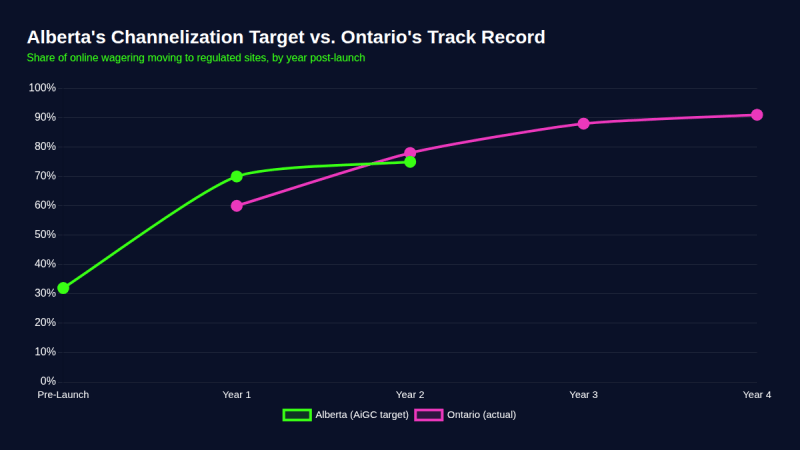
- We didn't have a channelization number to guess against in March, because AiGC hadn't published one yet. Alberta iGaming Corporation (AiGC) has since set a 70% channelization target for year one, rising to 75% by year two, against an estimated pre-launch grey-market share of roughly 70%.
- We don't expect Alberta's revenue to scale to Ontario's level, and neither does AiGC. Population, not market execution, explains most of the gap.
- We'll be watching Alberta's channelization rate, not its operator count, as the real test of whether this market is working the way AiGC expects.
We built this piece from public registration data and statements published by AGLC and AiGC, cross-referenced against iGaming Ontario's published market performance data, and supplemented with H2 Gambling Capital's revenue and channelization projections. Where we cite a projection rather than a confirmed outcome, we say so. We're also checking our own March 30, 2026 analysis, "What Alberta's Online Gambling Market Is Likely to Look Like Next," against this new data. That piece made directional predictions rather than numerical forecasts, since Alberta's regulator had not yet published specifics like a channelization target, so we are grading it on the calls it actually made rather than numbers it never claimed.


The Operator Count Is Climbing Fast
We counted 22 live operator sites at Alberta's launch. Those 22 came from a pool of roughly 50 entities that had registered with the Alberta Gaming, Liquor and Cannabis Commission (AGLC) ahead of launch day. We watched that number climb to 27 within a month, then to 28 as more brands completed the licensing process.
Entain moved its Sports Interaction and Party Casino brands into Alberta's regulated market on July 23. Entain's BetMGM joint venture had already launched on day one. Bally's followed on August 4 with Bally Bet and Monopoly Casino. We've also seen newer Alberta registrations from Videoslots, Mr Vegas, and GGPoker. GGPoker could become Alberta's first dedicated poker brand, which matters to us because poker liquidity has been one of the slower parts of the Canadian market to develop.
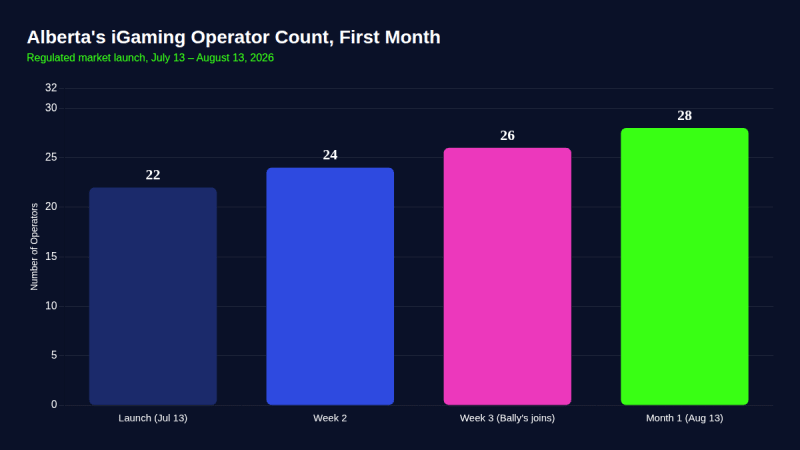
This chart tracks the growth in Alberta's licensed iGaming operator count during the market's first month, from launch on July 13 through August 13, 2026.
A few things stand out to us from the operator data:
- We think 28 operators in one month is a fast ramp by any Canadian benchmark. Six new operators joining a market in its first four weeks tells us the appetite for early entry is real, not speculative.
- We watched two large multinational brands, Entain and Bally's, move within three weeks of launch. Both already operate in Ontario, so their fast Alberta entry reads to us as confidence in the province's framework rather than a wait-and-see posture.
- We still count roughly 20 registered operators that haven't gone live yet. AGLC's original registration pool of about 50 entities means Alberta's operator count likely has more room to grow before this initial wave is complete.
Were We Right? Checking Our March Call
As we said in our March piece, we expected Alberta's shift from PlayAlberta's single-platform model to a competitive, multi-operator market to follow Ontario's pattern, specifically that the market "will not look finished on day one," pointing to Ontario's multi-year path to its current scale. Alberta's first month backs that up. Six operators joined in four weeks, and roughly 20 more remain registered but not yet live, which is not what a finished market looks like.
We also said in March that AGLC would likely maintain standardized player protections across brands, drawing on Ontario's AGCO Registrar's Standards for Internet Gaming as the template. All 28 of Alberta's current operators require RG Check accreditation and visible responsible gambling tools, so that call held too.
What we didn't guess right, because we couldn't, was the pace. We expected a gradual build resembling Ontario's, not a 27% jump in operator count inside a single month. And our March piece leaned on catalog breadth and supplier diversity as the maturity metric to watch, using CasinoRank's own iGaming Tracker data to compare game and supplier counts across Ontario, British Columbia, and Quebec, since that was the most concrete metric available before Alberta's launch. AiGC has instead centered its own definition of success on channelization, a number we simply didn't have in March because Alberta's regulator hadn't published one yet. We think channelization is the sharper metric, and it is the one we are tracking from here.
Why We're Watching the Channelization Target Closely
The Alberta iGaming Corporation (AiGC) conducts and manages Alberta's market on behalf of the province. AiGC set a channelization target of 70% of Alberta's online wagering moving to regulated sites within the first year. That target rises to 75% by the end of year two.
We think Alberta's 70% first-year target is ambitious. Alberta's estimated pre-launch grey-market share was roughly 70%, so AiGC is essentially asking the market to flip within twelve months. AiGC CEO Dan Keene said the corporation expects to outperform its initial projections. Keene described industry support since launch as having "exceeded" expectations.
This chart compares AiGC's channelization targets against Ontario's actual channelization performance in the years following its 2022 launch.
H2 Gambling Capital projects Alberta's regulated market share could climb from roughly 32% today toward 87% over the coming years. We see this as H2 Gambling Capital drawing a direct comparison to Ontario, where more than 90% of online gamblers now use licensed sites four years after that province's 2022 launch. If Alberta follows a similar curve, we'd expect the province's channelization numbers to look a lot like Ontario's by around 2030.
The Revenue Numbers, and Why They Won't Match Ontario's
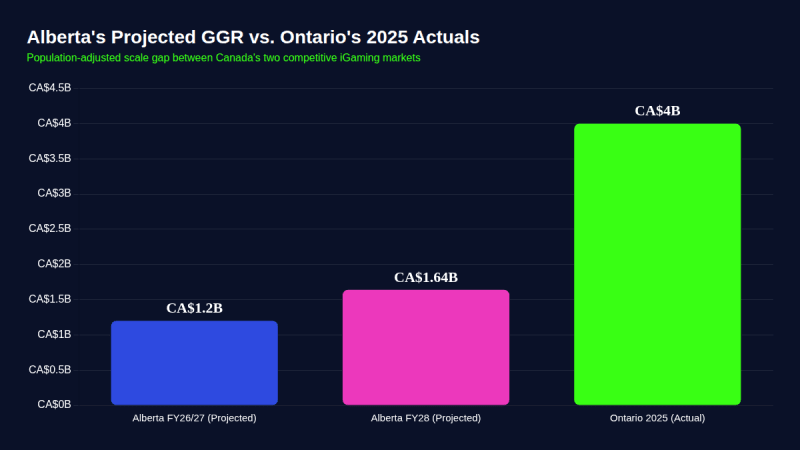
We don't expect Alberta's market to scale like Ontario's, and the numbers explain why. H2 Gambling Capital forecasts Alberta's regulated market will generate approximately CA$1.2 billion in gross gaming revenue in its first financial year, running April 2026 to March 2027. That figure rises to roughly CA$1.64 billion in FY28. AiGC projects Alberta's new market will produce around CA$76 million in provincial iGaming tax revenue in its first year.
This chart compares Alberta's projected gross gaming revenue for FY2026/27 and FY28 against Ontario's actual 2025 gross gaming revenue.
Ontario's 49 operators generated just over CA$4 billion in non-adjusted gross gaming revenue in 2025 alone. We'd point to population as the simplest explanation. Ontario's population of 16.1 million residents is more than three times Alberta's roughly 5 million residents. Alberta's operator count remains uncapped, but Alberta's smaller population means we don't expect Alberta and Ontario to scale in parallel.
A few things stand out to us from the interprovincial comparison:
- We think raw revenue comparisons between Alberta and Ontario are close to meaningless without adjusting for population. Per capita, Alberta's projected revenue trajectory looks broadly comparable to Ontario's early years.
- Alberta's uncapped operator model could eventually push its operator count past Ontario's 49, even though total market revenue will likely stay proportionally smaller given the population gap.
- We're treating Ontario's four-year channelization curve as the benchmark AiGC is trying to beat, not just match, based on Keene's public comments about exceeding internal projections.
What We're Watching Next
We'll be watching Alberta's channelization rate as the clearest signal of whether this market is working the way AiGC expects, since that is the number our March piece did not have and the one Alberta's regulator now treats as the real scorecard. We'll also be watching whether Alberta's operator count keeps growing past the October 13, 2026 grey-market transition deadline, which gives us a second checkpoint to revisit both this update and our original March call.
"Alberta's first month shows a market moving faster than its own regulator expected," said Eliza Radcliffe, Reviewer at BettingRanker. "Growing from 22 to 28 licensed operators in a matter of weeks, with major brands like Entain and Bally's completing their transitions almost immediately, tells me operators see real upside in establishing an early presence in Alberta rather than waiting to see how the market settles."
If Alberta's early momentum holds, we expect other Canadian provinces to start asking the same question Alberta just answered: whether a competitive, multi-operator market is worth the transition from a government monopoly. We'll keep tracking Alberta's numbers as they come in.